Image note
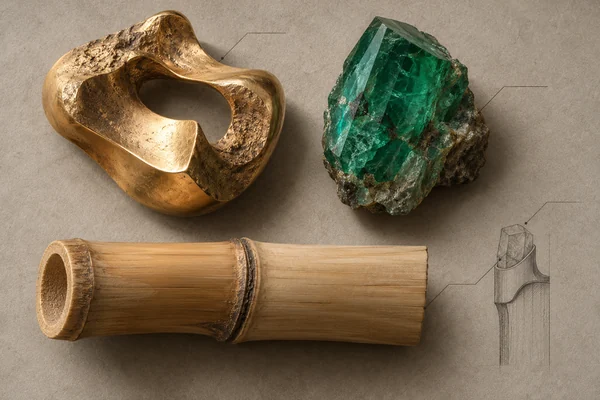
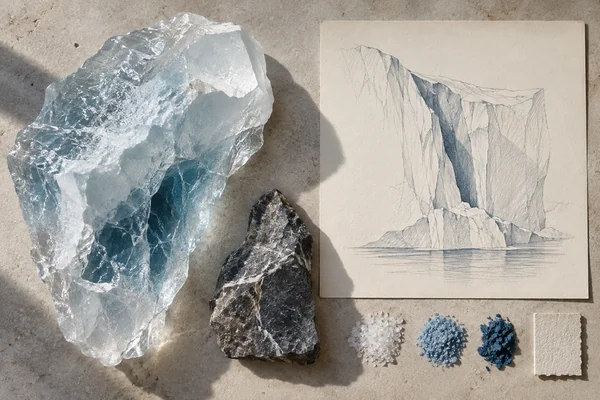
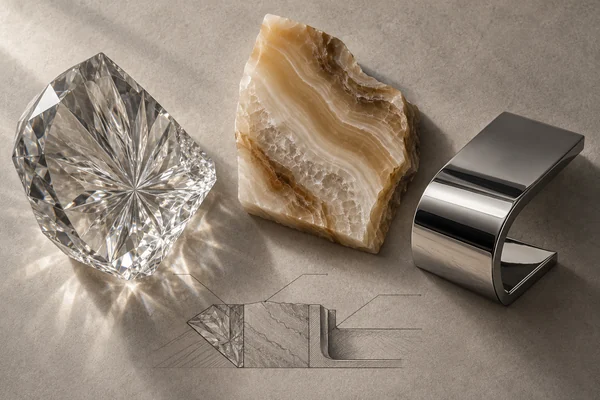
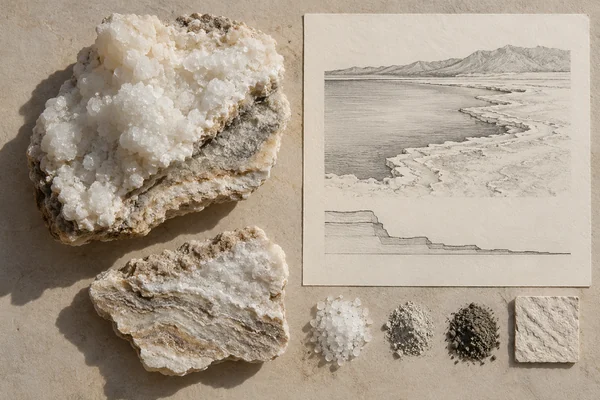
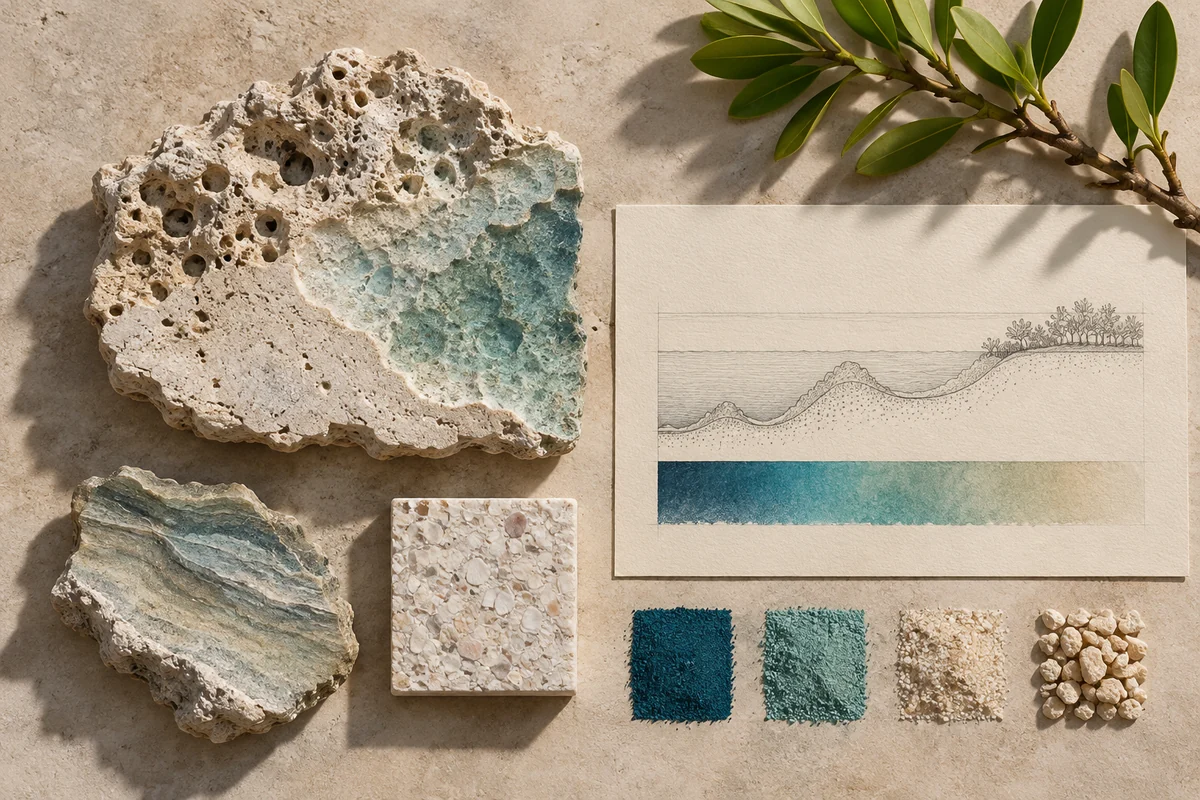
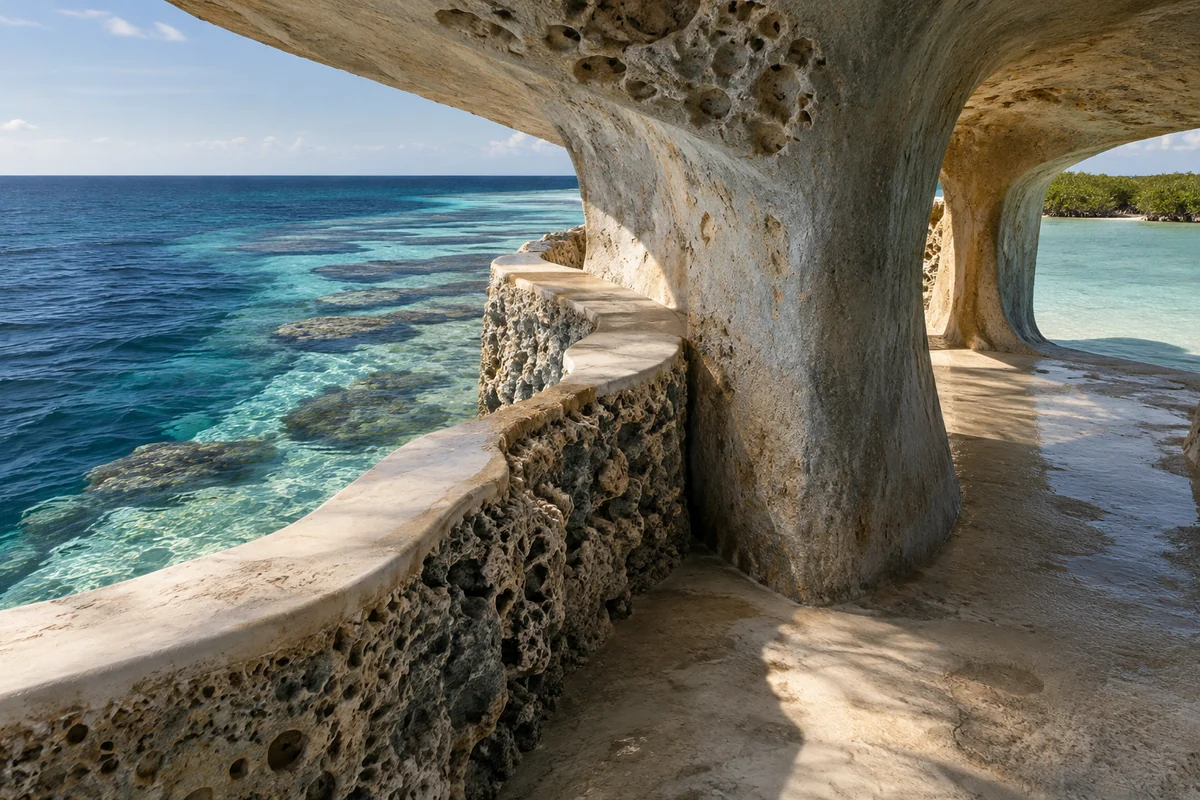
Three original interpretations of reef edges, cays & coastal lagoons, informed by Belize Barrier Reef Reserve System. These images explore material and spatial ideas; they are not documentary views or measured reconstructions of the reference. The palette is drawn from the material portrait.
Publication credit: The Chromologium.
Image credits and reuseThe colour strip is the entry’s study palette. Artwork sources and image credits and reuse terms are recorded in the archive.
Artwork recordThree views of one material idea.
The Belize Barrier Reef system connects reefs, atolls, sand cays, mangroves and lagoons. It is a reference for layered coastal boundaries rather than a source of building materials.
Read the material study01 / Reading the material
A coast with several edges
Belize’s reef system is a sequence of environments, not one line separating land and sea. Reef, lagoon, cay and mangrove suggest different kinds of boundary: broken, diffuse, enclosed and branching. Read those differences before reducing the landscape to a turquoise palette.
02 / From surface to space
Read the whole.
Then the edge.
An aerial view makes relationships visible that are hard to perceive at the waterline. In a study, distinguish the scale of a broad band from the fine texture within it. Colour can help describe the organization, but it should not be used alone to infer depth or ecological condition.
Trace the successive edges between open water, reef and lagoon. Compare colour changes with changes in depth and habitat.
03 / Colour in context
A palette you can work with.
Five tones drawn from the material portrait. Select a colour, compare it on paper and ink, or copy its value into your own study.
Surface
#6f5b3f
Colour values & paper / ink comparison
oklch(0.484 0.049 75.510) · primary
The colour stays fixed as its surroundings change.
Try the bench exercise
04 / At the bench
Make the observation tangible.
Build a layered colour composition with a broken outer edge and a quieter interior field. Use drawn contours or paper layers; do not collect reef material. Keep the palette an interpretation rather than a habitat measurement.
Keep a view of the whole beside a close detail. Note the material, lighting and the one variable you changed.
Source & orientation
Keep the reference close.
UNESCO World Heritage Centre. (n.d.). Belize Barrier Reef Reserve System. Retrieved October 10, 2026.
The material readings and bench exercise are editorial studies of this particular reference. The artwork explores its material ideas; the linked source documents the place.
Artwork & cartographic records
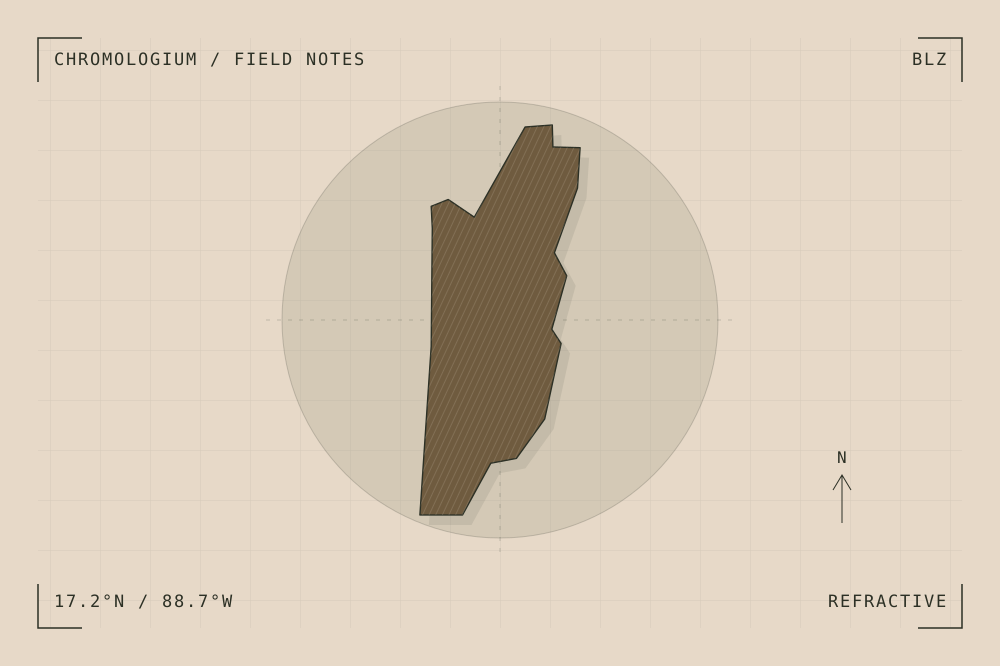
Artwork record · Geographic plate record. Map geometry: Natural Earth, public domain. The archive follows its map’s place names, including territories and disputed areas.
A closer look
Questions about this study
What does this study of Belize focus on?
The Belize Barrier Reef system connects reefs, atolls, sand cays, mangroves and lagoons. It is a reference for layered coastal boundaries rather than a source of building materials.
Where can I find the original reference?
Belize Barrier Reef Reserve System, published by UNESCO World Heritage Centre. The artwork explores the reference’s material ideas; the linked source documents the place.
What could I try at the bench?
Build a layered colour composition with a broken outer edge and a quieter interior field. Use drawn contours or paper layers; do not collect reef material. Keep the palette an interpretation rather than a habitat measurement.
Continue by material