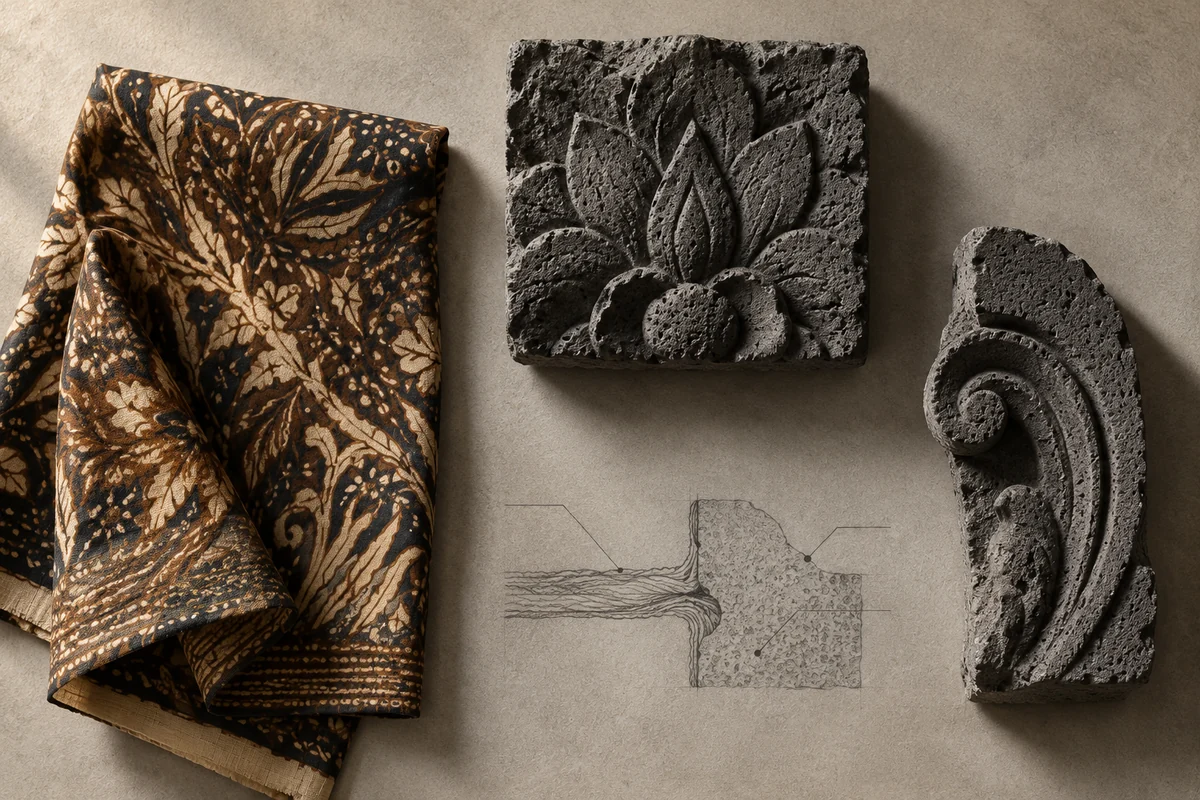
Image note
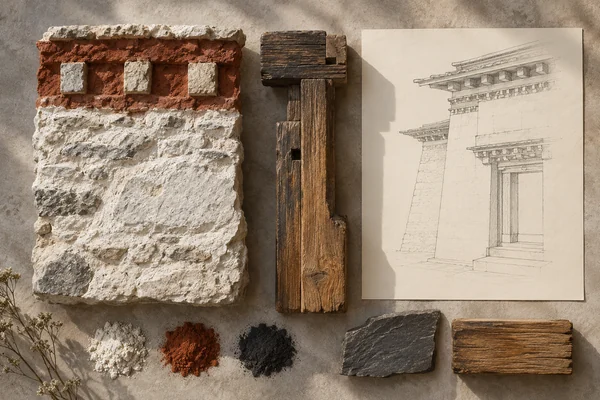
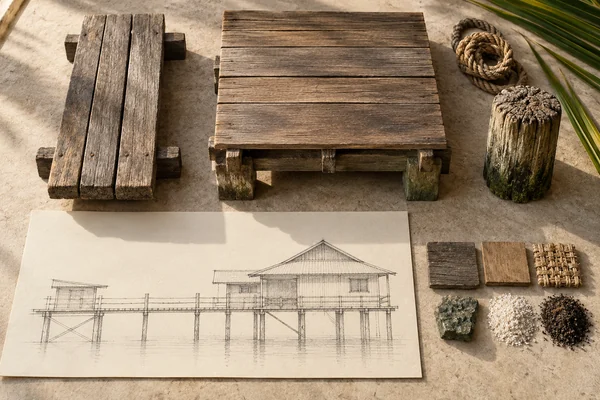
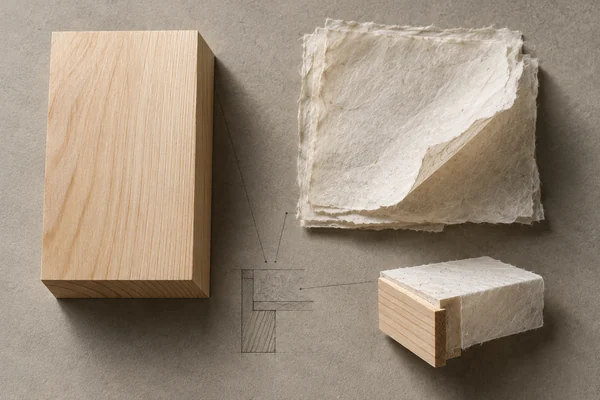
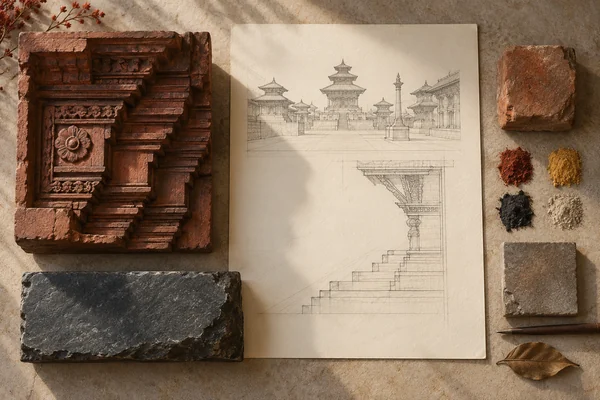
An interpretation of wax-resist cotton & carved volcanic stone. The architecture and section drawing are imagined studies, rather than records of a particular building or construction detail.
Publication credit: The Chromologium.
Image credits and reuseThe colour strip is the entry’s study palette. Artwork sources and image credits and reuse terms are recorded in the archive.
Artwork recordBatik — Wax, Dye & Reserve
Along the grain.
Notice how a directional surface gives even a quiet composition a sense of movement.
Material & Chromatic Spectrum
Calibrated OkLCH color science mapped from historical mineral pigments, architectural substrates, and intaglio inks.
Batik Indigo
#293E53
Colour values & paper / ink comparison
oklch(0.355904 0.045409 249.206427) · primary
The colour stays fixed as its surroundings change.
From Physical Lineage to Digital Space
“A study in repetition: the reserved ground matters as much as the coloured mark.”
This accession places Javanese batik beside Borobudur as an editorial comparison of repetition at two scales. Batik builds a surface through wax reservation and successive dyeing; the temple arranges reliefs and stupas along a changing route. For interface design, the useful questions are about rhythm, intervals and what remains unfilled. These are contemporary design interpretations, not claims that either tradition anticipated software. The five colours are an authored palette, not measurements of the pictured objects or a summary of Indonesia’s many cultures.
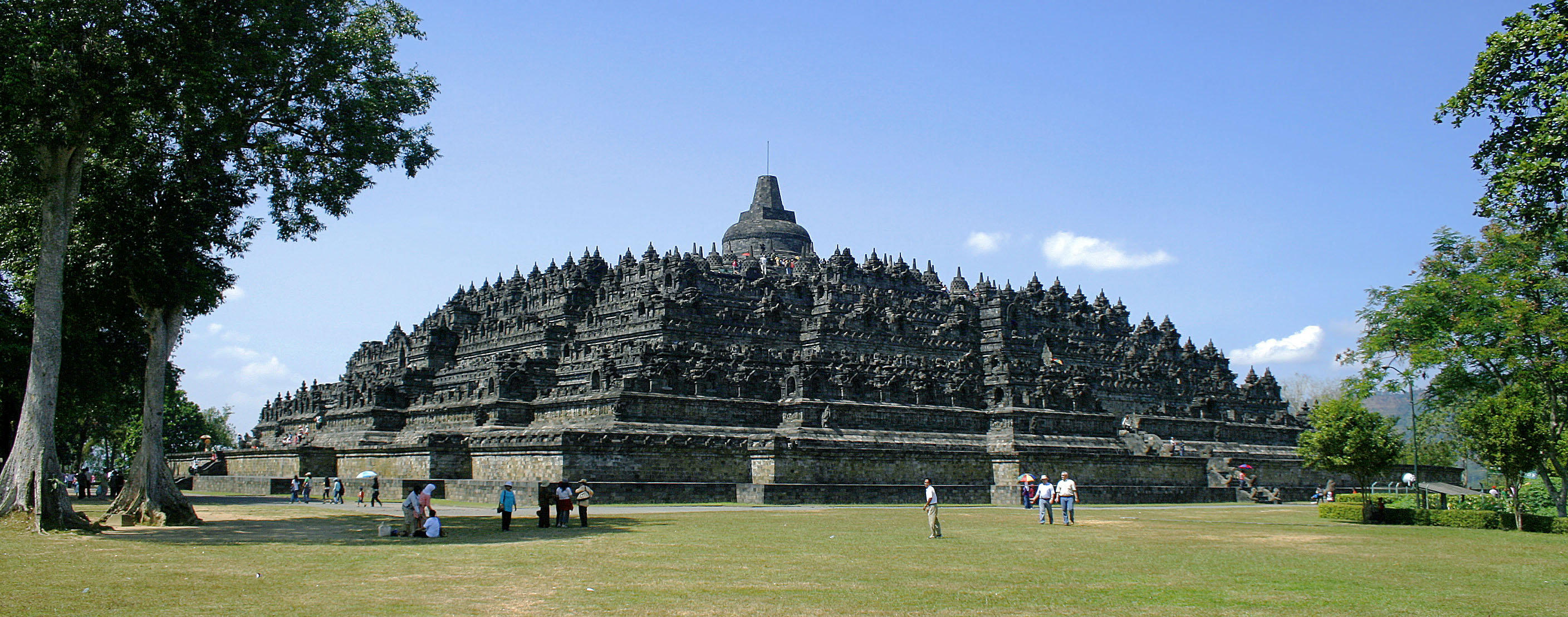
Borobudur
In Central Java, square terraces give way to circular platforms and openwork stupas. Carved reliefs and repeated stone forms make the visitor’s route part of the architectural composition.
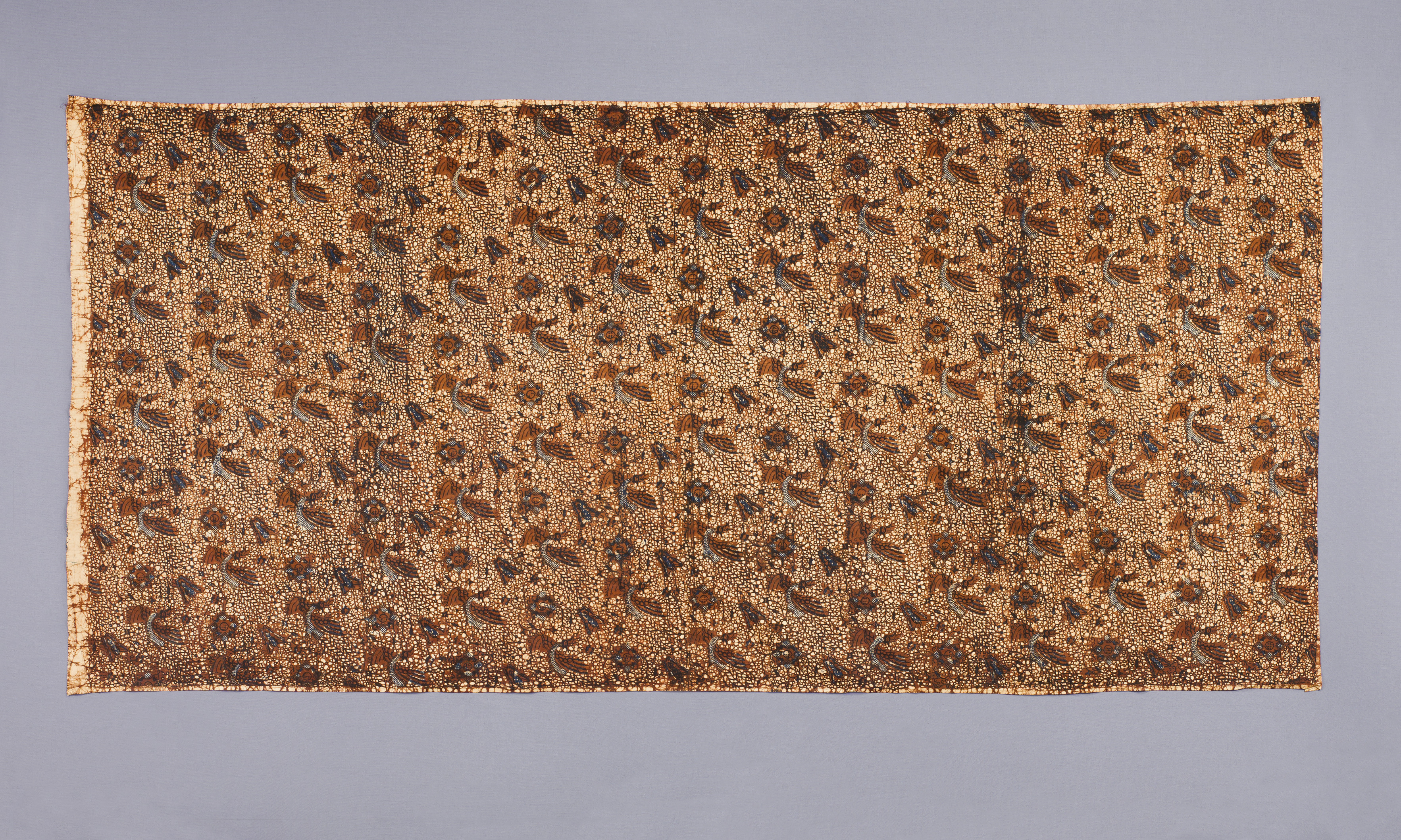
Hip Wrapper (kain panjang)
The primary compositional study embodying Indonesia's national color philosophy, surface chemistry, and aesthetic tension.
Experiment with this palette
Dynamic Component Diorama
Real-time rendering of interactive UI primitives styled with Indonesia's sovereign design tokens.
Batik — Wax, Dye & Reserve
Tactile surface responding with 0.5 optical friction and overdamped (quiet) kinetics.
Explore the global map
Indonesia in the Global Material Cartography
Spatial provenance, trade route vectors, solar diurnal phase, and localized craft beacons across Indonesia.
Regional craft hubs & cities
Regional Craft Hubs & Historical Cities
Granular material lineages, landmark architecture, and specialized regional craft centers across Indonesia.
Borobudur’s terraces provide the architectural focus of this accession. The interface coefficients are illustrative settings rather than field measurements.
The Saint Louis Art Museum records the featured kain panjang as made in Surakarta, Central Java, in the early twentieth century.
Material specifications & sound
Sensory Specifications & Surface Friction
CULTURAL ACOUSTIC LINEAGE & PROVENANCE
An interface cue authored for this specimen; it does not reproduce a Javanese instrument or tuning system.
PSYCHOACOUSTIC & COGNITIVE PROFILE
A restrained low-register cue for selection feedback.
DIGITAL UI TRANSLATION SPEC
Synthesized live via the browser's Web Audio API with exponential gain decay and fifth-harmonic overtone dispersion to provide tactile, non-speech micro-interaction feedback.
Connected Systems & Lexicon Axioms
“Indonesia: Design Provenance & Material Spectrum.” The Chromologium — Design Atlas, 2026. chromologium.com/atlas/indonesia
Primary references
Return to the source.
A closer look
Questions about this study
What material idea connects this study of Indonesia?
Batik — Wax, Dye & Reserve: A study in repetition: the reserved ground matters as much as the coloured mark. Notice how a directional surface gives even a quiet composition a sense of movement.
Which building can I use as a reference?
Borobudur (8th–9th centuries). In Central Java, square terraces give way to circular platforms and openwork stupas. Carved reliefs and repeated stone forms make the visitor’s route part of the architectural composition. Read the heritage record.
How can I work with these colours?
Select a swatch in the palette to copy its HEX value, then expand the paper and ink comparison to see how the surrounding ground changes its appearance. The optional experiment lets you try the palette on interface elements.
Continue by material