Image note
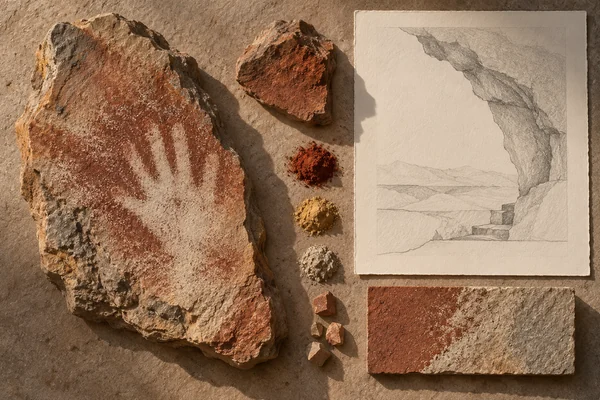
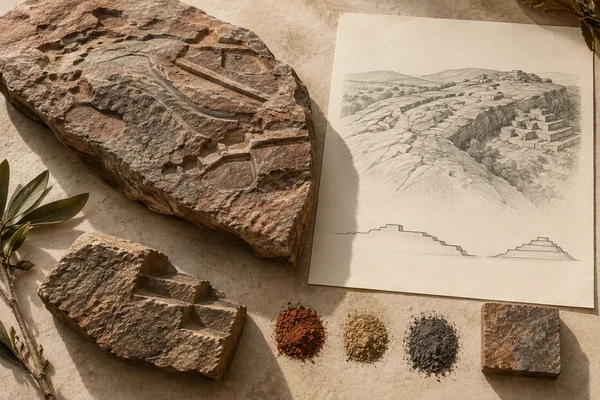
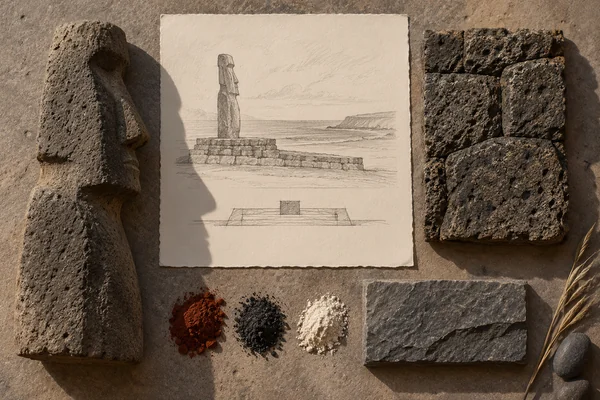
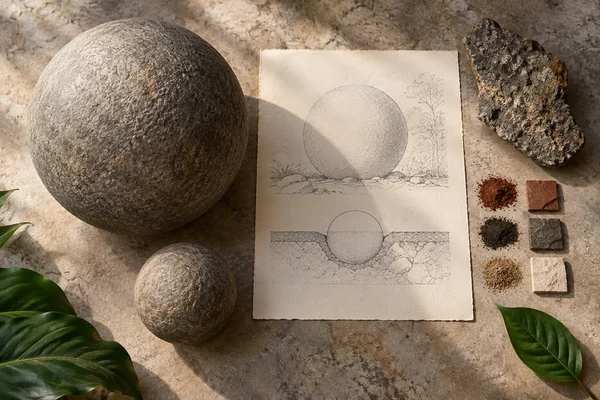
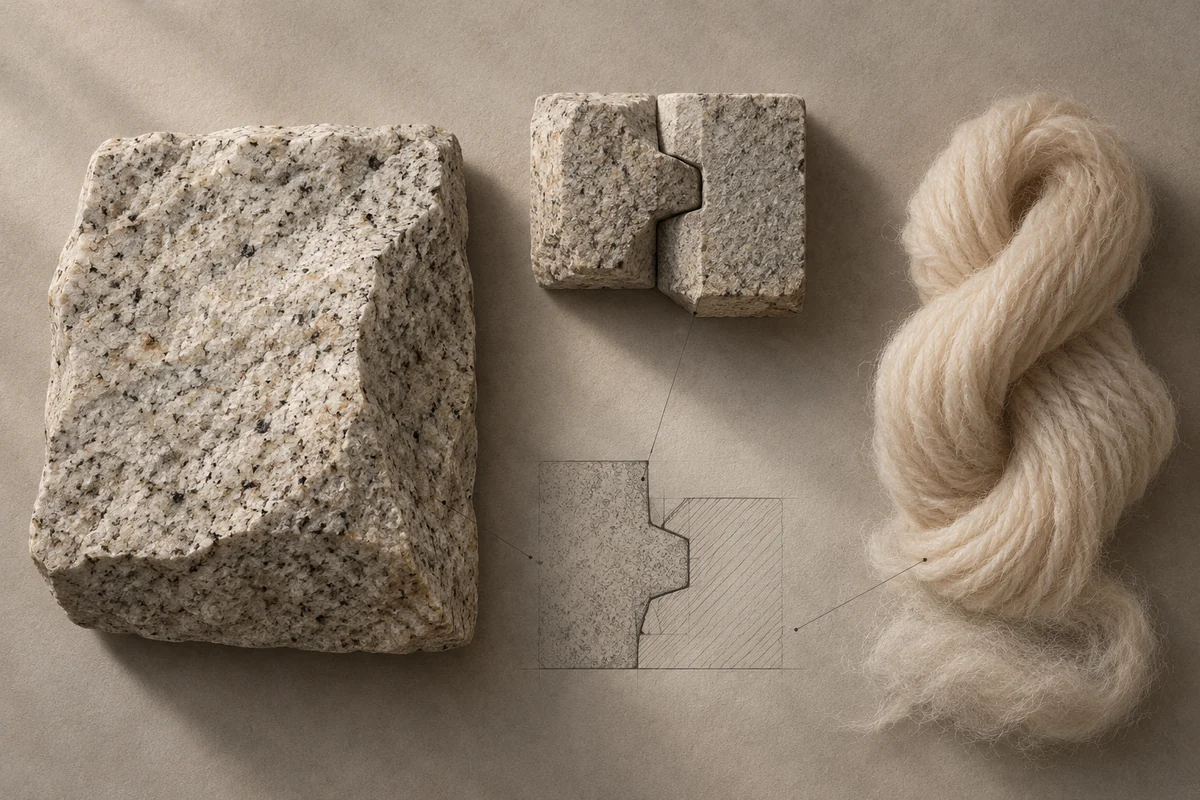
An interpretation of white granite cyclopean blocks & alpaca wool. The architecture and section drawing are imagined studies, rather than records of a particular building or construction detail.
Publication credit: The Chromologium.
Image credits and reuseThe colour strip is the entry’s study palette. Artwork sources and image credits and reuse terms are recorded in the archive.
Artwork recordInca Ashlar Masonry & Paracas Chromatic Weaving
Weight. Light. Time.
Move between the mass of the architecture and the small variations within its surfaces.
Material & Chromatic Spectrum
Calibrated OkLCH color science mapped from historical mineral pigments, architectural substrates, and intaglio inks.
Inca Cochineal
#D91023
Colour values & paper / ink comparison
oklch(0.50 0.23 25) · primary
The colour stays fixed as its surroundings change.
From Physical Lineage to Digital Space
“Fit stone to stone so tightly that a knife blade cannot pass; fit color to fiber so deeply that centuries cannot fade it.”
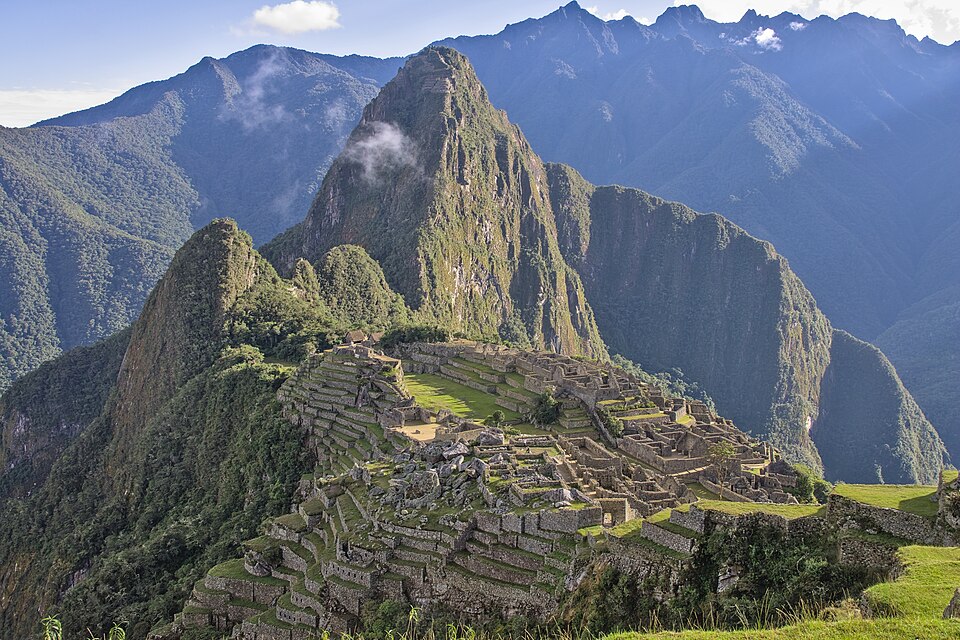
Inca cyclopean masonry carved massive granite boulders into 12-sided interlocking polygon puzzle pieces that shift during earthquakes and slide back into perfect alignment. This seismic resilience achieved through non-rectilinear geometry provides the ultimate metaphor for robust, responsive digital design systems that gracefully adapt under extreme viewport stress.
Machu Picchu
The supreme masterpiece of Ashlar cyclopean masonry — massive granite stones carved with interlocking multi-angle joints fitted without mortar to withstand major earthquakes.
Artwork reproduction unavailable.
Wrong-subject map; catalogue retained as a citation-only record until a permitted matching reproduction is available.
Paracas Necropolis Ceremonial Mantle
The primary compositional study embodying Peru's national color philosophy, surface chemistry, and aesthetic tension.
Experiment with this palette
Dynamic Component Diorama
Real-time rendering of interactive UI primitives styled with Peru's sovereign design tokens.
Inca Ashlar Masonry & Paracas Chromatic Weaving
Tactile surface responding with 0.34 optical friction and overdamped (quiet) kinetics.
Explore the global map
Peru in the Global Material Cartography
Spatial provenance, trade route vectors, solar diurnal phase, and localized craft beacons across Peru.
Regional craft hubs & cities
Regional Craft Hubs & Historical Cities
Granular material lineages, landmark architecture, and specialized regional craft centers across Peru.
The primary urban design center showcasing Peru's definitive spatial landmarks and historical Inca Ashlar Masonry & Paracas Chromatic Weaving craft traditions.
Regional artisan workshops preserving ancestral material extraction, pigment chemistry, and tactile fabrication techniques.
Modern architectural studios translating traditional tactile properties into scalable digital user interfaces and physical environments.
Material specifications & sound
Sensory Specifications & Surface Friction
CULTURAL ACOUSTIC LINEAGE & PROVENANCE
Andean dual-player Siku (panflute) traditions rely on hocketing—two musicians interlocking alternating notes to create a single continuous acoustic line across vast Andean mountain valleys.
PSYCHOACOUSTIC & COGNITIVE PROFILE
659 Hz (E5) airy double-pipe resonance, fostering collaborative flow, breath awareness, and spatial depth.
DIGITAL UI TRANSLATION SPEC
Synthesized live via the browser's Web Audio API with exponential gain decay and fifth-harmonic overtone dispersion to provide tactile, non-speech micro-interaction feedback.
Connected Systems & Lexicon Axioms
“Peru: Design Provenance & Material Spectrum.” The Chromologium — Design Atlas, 2026. chromologium.com/atlas/peru
Primary references
Return to the source.
A closer look
Questions about this study
What material idea connects this study of Peru?
Inca Ashlar Masonry & Paracas Chromatic Weaving: Fit stone to stone so tightly that a knife blade cannot pass; fit color to fiber so deeply that centuries cannot fade it. Move between the mass of the architecture and the small variations within its surfaces.
Which building can I use as a reference?
Machu Picchu (c. 1450). The supreme masterpiece of Ashlar cyclopean masonry — massive granite stones carved with interlocking multi-angle joints fitted without mortar to withstand major earthquakes. Read the heritage record.
How can I work with these colours?
Select a swatch in the palette to copy its HEX value, then expand the paper and ink comparison to see how the surrounding ground changes its appearance. The optional experiment lets you try the palette on interface elements.
Continue by material