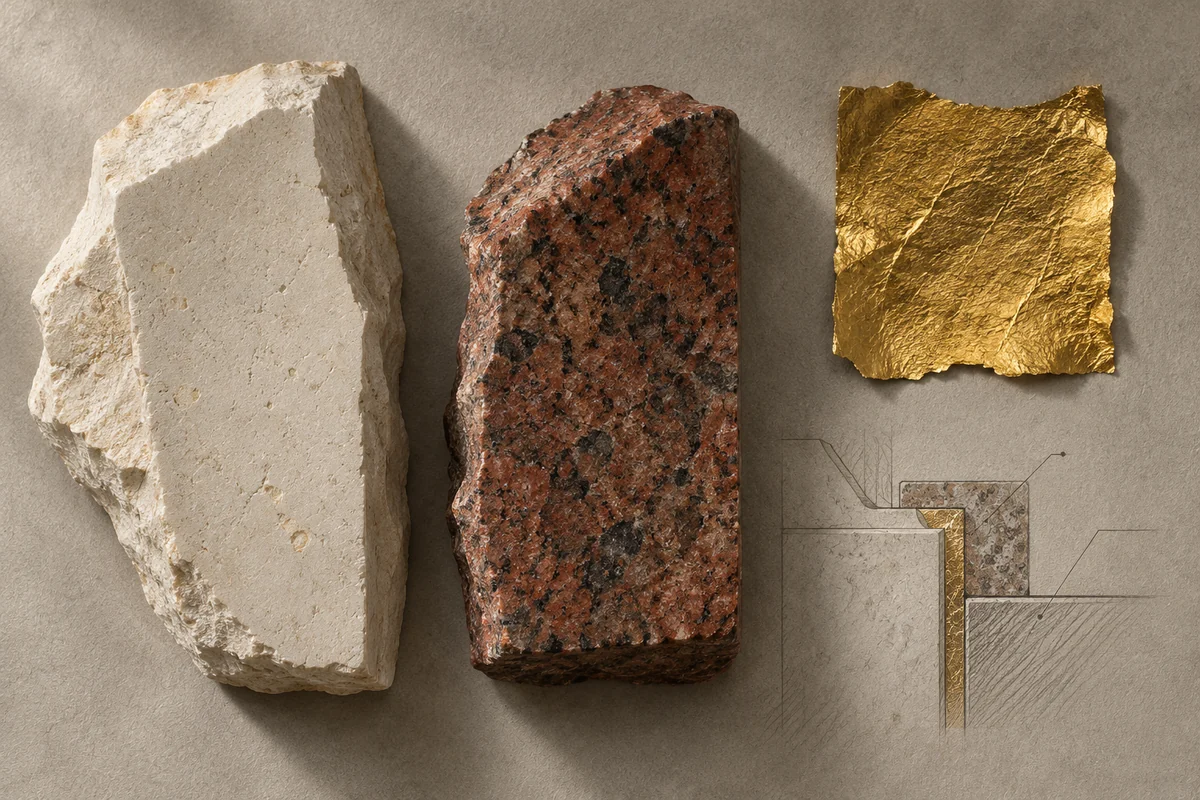
Image note
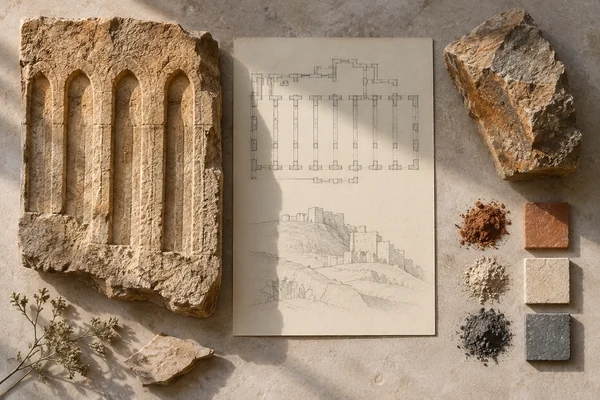
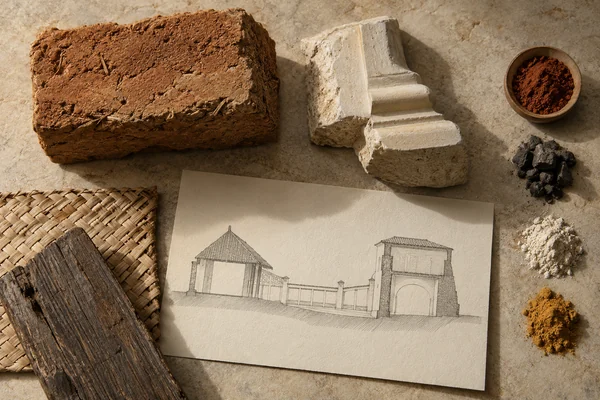
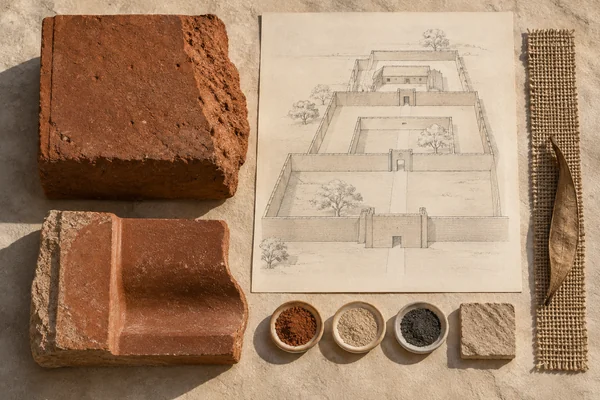
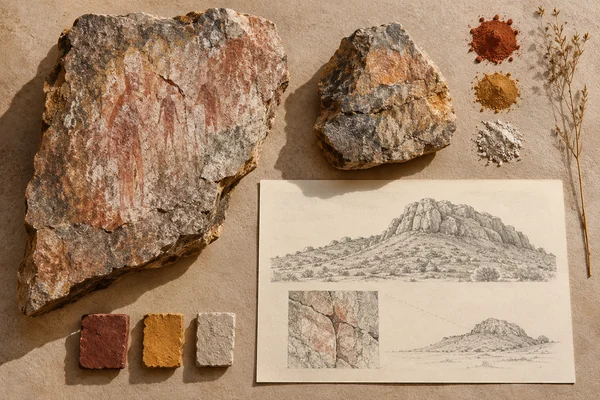
An interpretation of tura limestone, red granite & gold leaf. The architecture and section drawing are imagined studies, rather than records of a particular building or construction detail.
Publication credit: The Chromologium.
Image credits and reuseThe colour strip is the entry’s study palette. Artwork sources and image credits and reuse terms are recorded in the archive.
Artwork recordMonumental Geometry & Solar Axial Alignment
Weight. Light. Time.
Move between the mass of the architecture and the small variations within its surfaces.
Material & Chromatic Spectrum
Calibrated OkLCH color science mapped from historical mineral pigments, architectural substrates, and intaglio inks.
Pharaonic Gold
#C5A059
Colour values & paper / ink comparison
oklch(0.70 0.11 82) · primary
The colour stays fixed as its surroundings change.
From Physical Lineage to Digital Space
“Man fears time, but time fears the pyramids; permanence is built through absolute geometric clarity.”
Egyptian spatial design linked terrestrial monuments directly to celestial coordinates and solar trajectories. By aligning monumental stone portals with solstice dawn rays, ancient Egyptian architects invented the world's first diurnal interface—a spiritual predecessor to the Chromologium’s circadian token engine and ambient time-responsive UX.
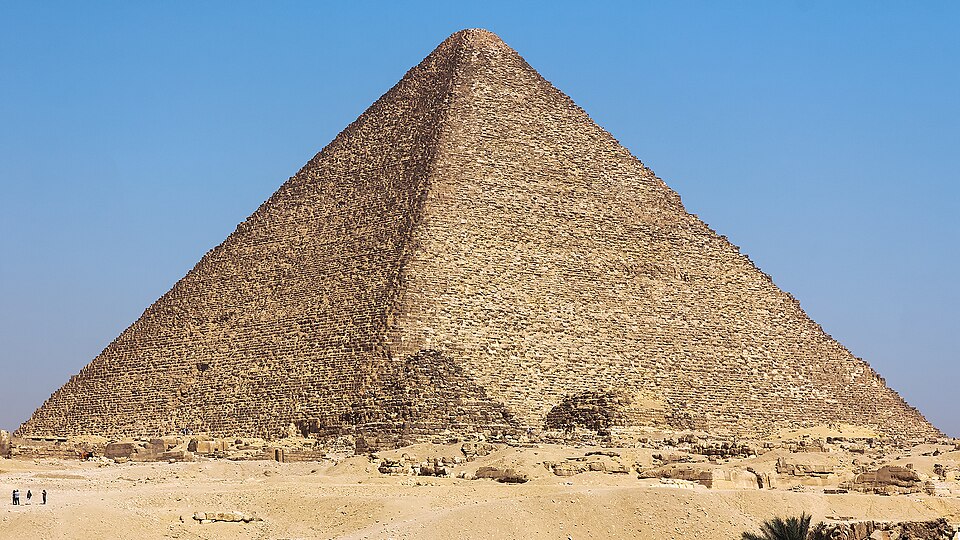
Great Pyramid of Giza
The oldest and only surviving Wonder of the Ancient World — monumental limestone engineering aligned to true north with micro-millimeter precision.
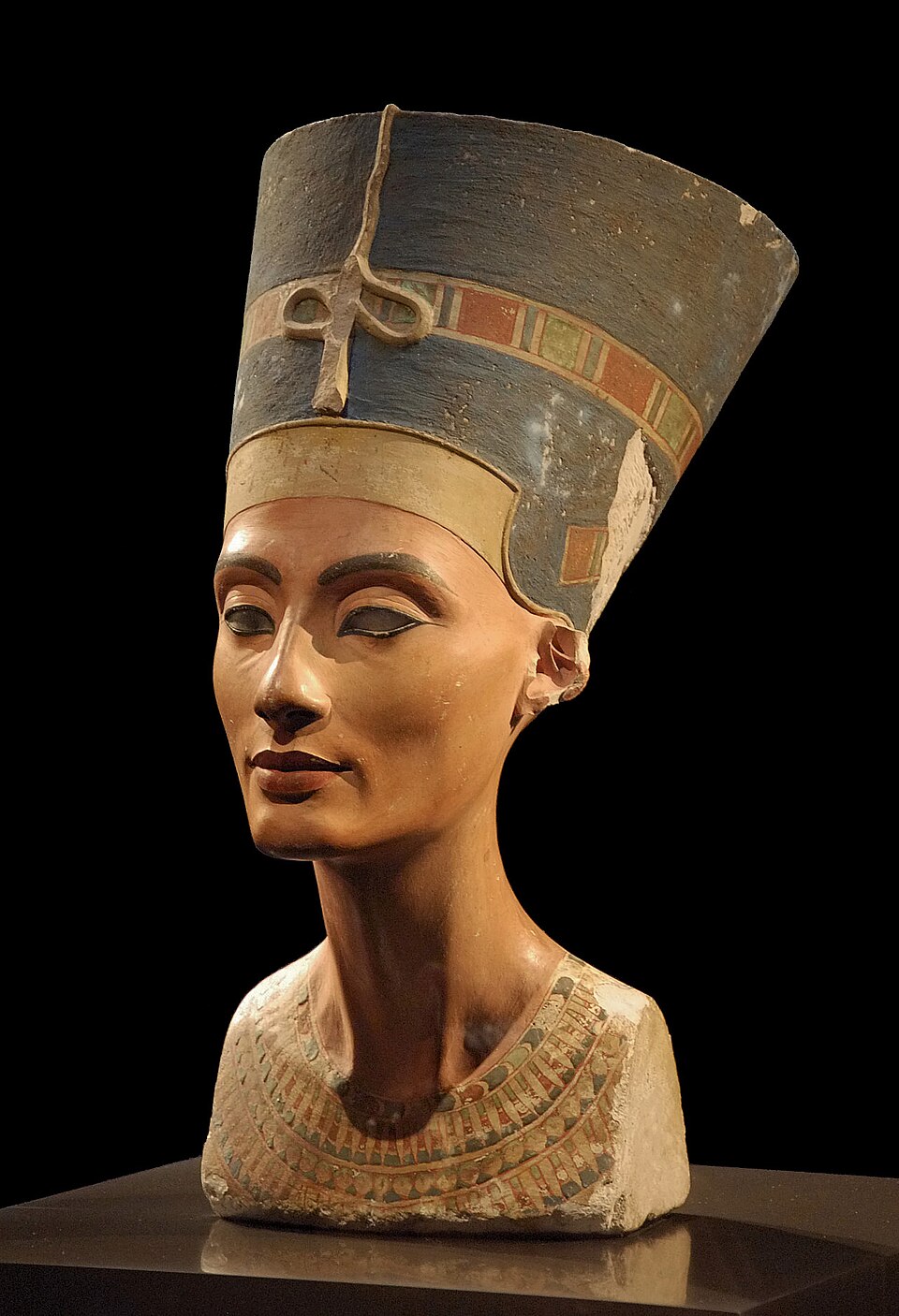
Bust of Nefertiti
The primary compositional study embodying Egypt's national color philosophy, surface chemistry, and aesthetic tension.
Experiment with this palette
Dynamic Component Diorama
Real-time rendering of interactive UI primitives styled with Egypt's sovereign design tokens.
Monumental Geometry & Solar Axial Alignment
Tactile surface responding with 0.3 optical friction and overdamped (quiet) kinetics.
Explore the global map
Egypt in the Global Material Cartography
Spatial provenance, trade route vectors, solar diurnal phase, and localized craft beacons across Egypt.
Regional craft hubs & cities
Regional Craft Hubs & Historical Cities
Granular material lineages, landmark architecture, and specialized regional craft centers across Egypt.
The primary urban design center showcasing Egypt's definitive spatial landmarks and historical Monumental Geometry & Solar Axial Alignment craft traditions.
Regional artisan workshops preserving ancestral material extraction, pigment chemistry, and tactile fabrication techniques.
Modern architectural studios translating traditional tactile properties into scalable digital user interfaces and physical environments.
Material specifications & sound
Sensory Specifications & Surface Friction
CULTURAL ACOUSTIC LINEAGE & PROVENANCE
The sacred Hathoric Sistrum (sesheshet)—a bronze frame with sliding metallic cross-bars—emitted rustling and ringing tones to ward off disorder, mirrored in the ancient bronze cymbals of the Nile liturgy.
PSYCHOACOUSTIC & COGNITIVE PROFILE
554 Hz (C#5) shimmering metallic timbre, sharpening attention, solemn vigilance, and ceremonial focus.
DIGITAL UI TRANSLATION SPEC
Synthesized live via the browser's Web Audio API with exponential gain decay and fifth-harmonic overtone dispersion to provide tactile, non-speech micro-interaction feedback.
Connected Systems & Lexicon Axioms
“Egypt: Design Provenance & Material Spectrum.” The Chromologium — Design Atlas, 2026. chromologium.com/atlas/egypt
Primary references
Return to the source.
A closer look
Questions about this study
What material idea connects this study of Egypt?
Monumental Geometry & Solar Axial Alignment: Man fears time, but time fears the pyramids; permanence is built through absolute geometric clarity. Move between the mass of the architecture and the small variations within its surfaces.
Which building can I use as a reference?
Great Pyramid of Giza (c. 2560 BCE). The oldest and only surviving Wonder of the Ancient World — monumental limestone engineering aligned to true north with micro-millimeter precision. Read the heritage record.
How can I work with these colours?
Select a swatch in the palette to copy its HEX value, then expand the paper and ink comparison to see how the surrounding ground changes its appearance. The optional experiment lets you try the palette on interface elements.
Continue by material