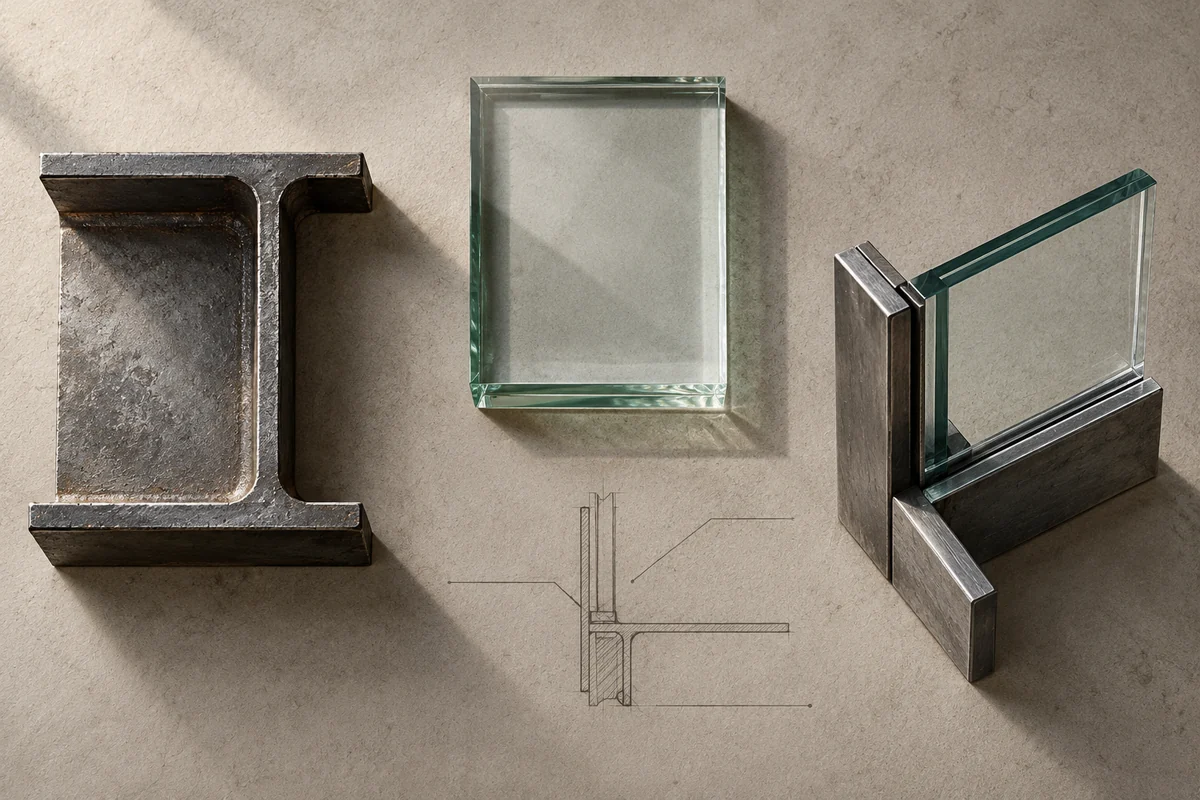
Image note
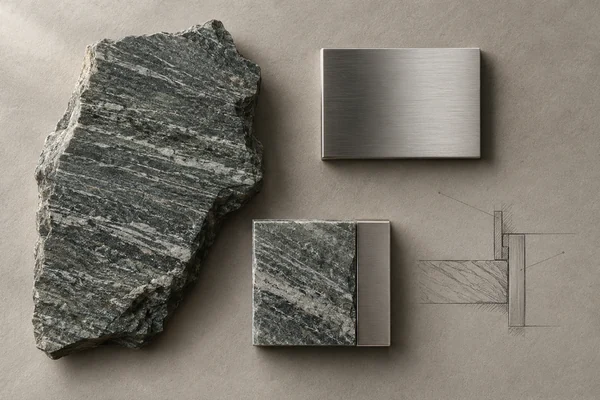
An interpretation of industrial steel & plate glass. The architecture and section drawing are imagined studies, rather than records of a particular building or construction detail.
Publication credit: The Chromologium.
Image credits and reuseThe colour strip is the entry’s study palette. Artwork sources and image credits and reuse terms are recorded in the archive.
Artwork recordBauhaus Rationalism
The precision of a surface.
Read the edges, repeated intervals and reflected highlights before the whole composition.
Material & Chromatic Spectrum
Calibrated OkLCH color science mapped from historical mineral pigments, architectural substrates, and intaglio inks.
Bauhaus Rot
#DD0000
Colour values & paper / ink comparison
oklch(0.53 0.24 28) · primary
The colour stays fixed as its surroundings change.
From Physical Lineage to Digital Space
“Form follows function, but function without beauty is engineering without humanity.”
The Bauhaus workshop manifesto unified industrial manufacturing with pure elemental geometry. By stripping away non-essential ornament and codifying color into functional hierarchies, Walter Gropius and Johannes Itten established the direct ancestor of modern W3C DTCG design tokens, atomic design systems, and standardized component states.
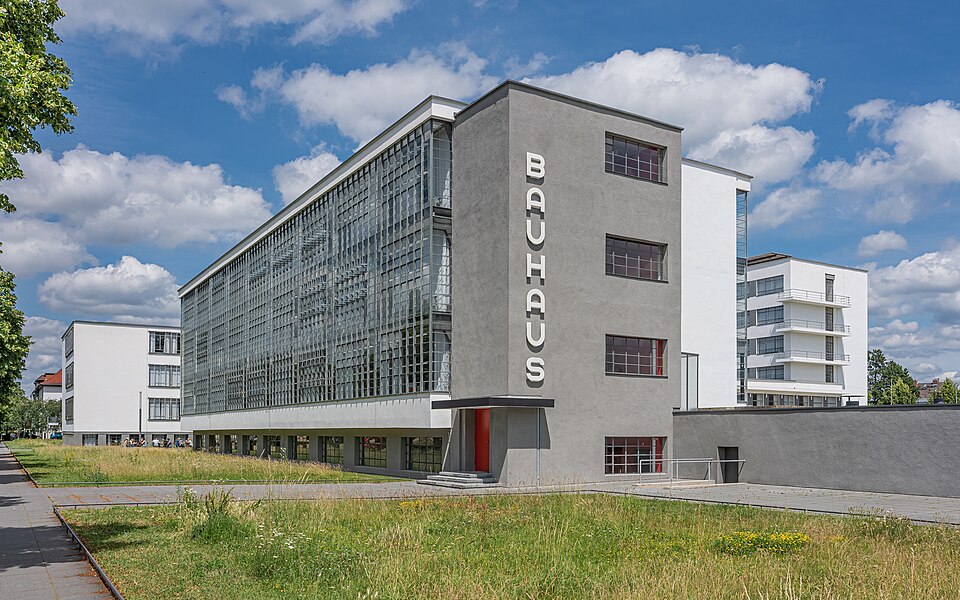
Bauhaus Dessau
The school that unified art and technology — its glass curtain wall, asymmetric plan, and workshop-studio integration became the DNA of modern design education.

Wanderer above the Sea of Fog
The primary compositional study embodying Germany's national color philosophy, surface chemistry, and aesthetic tension.
Experiment with this palette
Dynamic Component Diorama
Real-time rendering of interactive UI primitives styled with Germany's sovereign design tokens.
Bauhaus Rationalism
Tactile surface responding with 0.08 optical friction and critically damped (crisp) kinetics.
Explore the global map
Germany in the Global Material Cartography
Spatial provenance, trade route vectors, solar diurnal phase, and localized craft beacons across Germany.
Regional craft hubs & cities
Regional Craft Hubs & Historical Cities
Granular material lineages, landmark architecture, and specialized regional craft centers across Germany.
The birth of modernist functionalism: structural steel skeleton, non-load-bearing glass envelopes, and rational primary color balance.
A profound tension between pure Miesian universal steel-and-glass pavilions and raw, layered cold-war concrete urban textures.
The intellectual foundation of modern system design and digital ergonomics, where Dieter Rams and Otl Aicher codified structural usability.
Lightweight minimal-surface tensile architecture mimicking soap bubbles and spider webs, suspended over rolling Bavarian parkland.
Material specifications & sound
Sensory Specifications & Surface Friction
CULTURAL ACOUSTIC LINEAGE & PROVENANCE
Germany codified the modern international acoustic standard at the 1939 London Conference, adopting Stuttgart's 440 Hz standard (Kammerton A). German design philosophy (Bauhaus, HfG Ulm) emphasized purely functional, unornamented acoustic signals for industrial machinery and telecommunication systems.
PSYCHOACOUSTIC & COGNITIVE PROFILE
440 Hz (A4) balanced sawtooth-filtered tone, providing unambiguous cognitive confirmation with zero decorative fatigue.
DIGITAL UI TRANSLATION SPEC
Synthesized live via the browser's Web Audio API with exponential gain decay and fifth-harmonic overtone dispersion to provide tactile, non-speech micro-interaction feedback.
Connected Systems & Lexicon Axioms
“Germany: Design Provenance & Material Spectrum.” The Chromologium — Design Atlas, 2026. chromologium.com/atlas/germany
Primary references
Return to the source.
A closer look
Questions about this study
What material idea connects this study of Germany?
Bauhaus Rationalism: Form follows function, but function without beauty is engineering without humanity. Read the edges, repeated intervals and reflected highlights before the whole composition.
Which building can I use as a reference?
Bauhaus Dessau (1925–1926). The school that unified art and technology — its glass curtain wall, asymmetric plan, and workshop-studio integration became the DNA of modern design education. Read the heritage record.
How can I work with these colours?
Select a swatch in the palette to copy its HEX value, then expand the paper and ink comparison to see how the surrounding ground changes its appearance. The optional experiment lets you try the palette on interface elements.
Continue by material